
eBay resale profit: margin, ROI and a downside scenario
Updated:
Quick answer
A deal surplus is the sale income minus purchase and selling costs. Margin divides that surplus by sale income. ROI on purchase cost divides it by the purchase cost. These measures answer different questions; a high percentage does not ensure a worthwhile amount of money.
This is a planning framework for sellers in Germany, not an accounting determination of taxable profit. Use a consistent tax basis. Working time, returns and overheads need separate treatment where they matter.
Keep the denominators visible
- Surplus = received item and shipping income − purchase − modeled selling costs.
- Margin = surplus ÷ that income × 100.
- Purchase-cost ROI = surplus ÷ purchase price × 100.
Calling the last measure “ROI” without naming its denominator can mislead. It does not measure your return on every expense or the speed at which capital becomes available again.
Hypothetical example: a lower sale price
Assume a EUR 35 purchase and EUR 16 combined fees, postage and packaging, with no separate shipping income. All amounts are invented; EUR 16 is a scenario allowance, not a fee quote or a claim that fees stay constant in a real sale.
| Measure | EUR 79 sale scenario | EUR 69 sale scenario |
|---|---|---|
| Income | EUR 79.00 | EUR 69.00 |
| Purchase + assumed selling costs | EUR 51.00 | EUR 51.00 |
| Surplus | EUR 28.00 | EUR 18.00 |
| Margin on income | 35.44% | 26.09% |
| ROI on purchase | 80.00% | 51.43% |
The EUR 10 discount reduces the planned surplus by 35.71% under this fixed-cost assumption. In a full calculation, recalculate percentage fees for the lower price too. Comparing only the original ROI would conceal how much room you have to negotiate.
Performed calculator test: who pays for shipping?
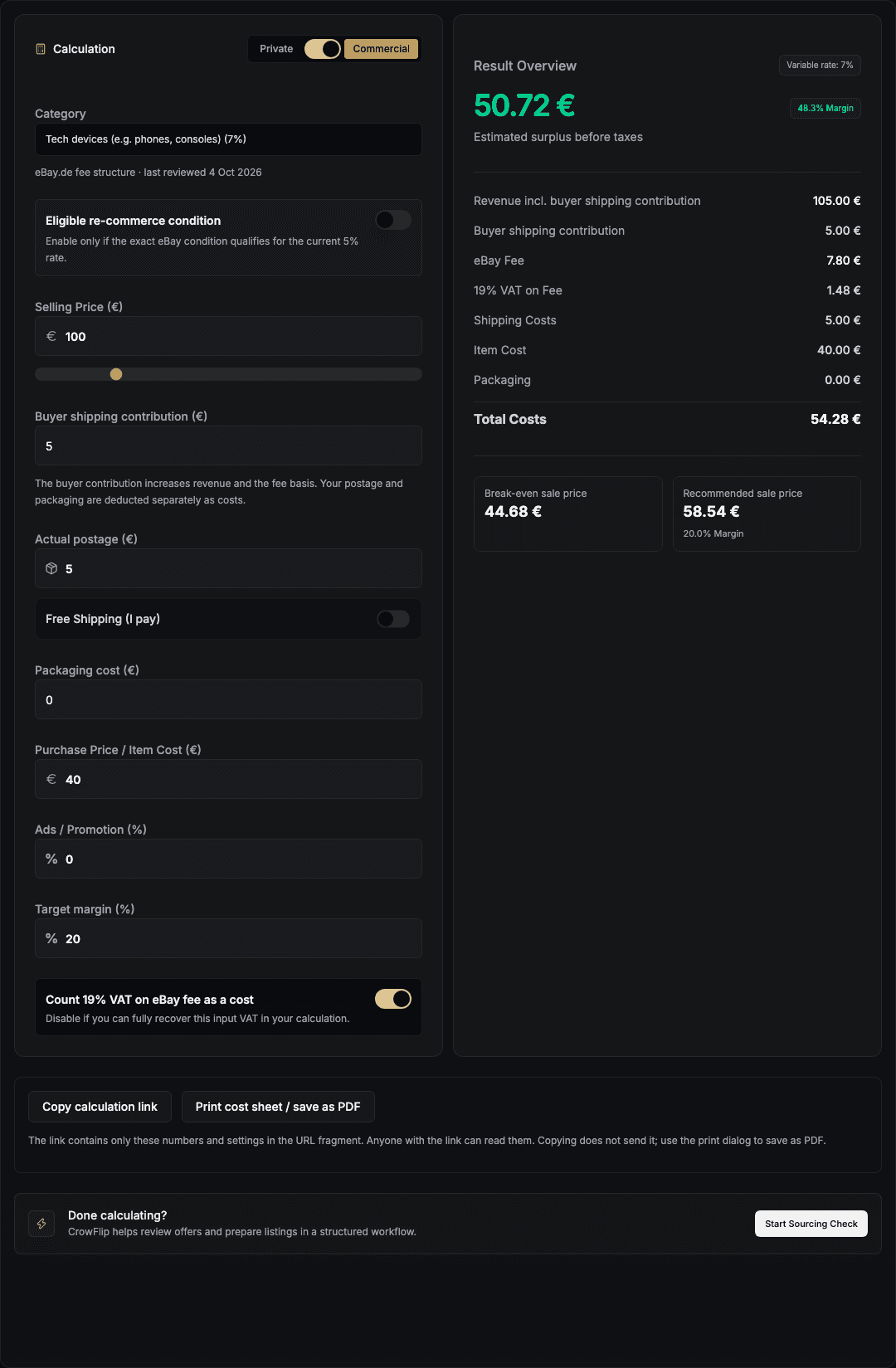
On 12 October 2026, we operated the CrowFlip eBay calculator in a local browser with four input scenarios. The amounts are assumed; no item was sold. This checks whether the interface reproduces the calculations below. The screenshot and screen recording below the article show the calculator workflow.
Shared inputs: EUR 100 item price, EUR 40 purchase cost, EUR 5 actual postage and 0% advertising. In the first three scenarios, buyer-paid shipping is EUR 5 and packaging is EUR 0; free shipping sets only the buyer contribution to EUR 0. The fourth scenario independently sets buyer-paid shipping to EUR 7 and packaging to EUR 1.
| Input scenario | Income | Modeled costs | Displayed surplus |
|---|---|---|---|
| Private, buyer pays shipping, no optional fees | EUR 105.00 | 40 + 5 = EUR 45.00 | EUR 60.00 |
| Private, seller offers free shipping | EUR 100.00 | 40 + 5 = EUR 45.00 | EUR 55.00 |
| Business, tech devices at 7%, buyer pays shipping | EUR 105.00 | 40 + 5 + 7.80 + 1.482 = EUR 54.282 | EUR 50.72 |
| Business, EUR 7 buyer contribution, EUR 5 postage and EUR 1 packaging | EUR 107.00 | 40 + 5 + 1 + 7.94 + 1.5086 = EUR 55.4486 | EUR 51.55 |
For the business demo, re-commerce eligibility stays off and 19% VAT on the fee counts as a cost: 105 × 7% + 0.45 = EUR 7.80 fee; 7.80 × 19% = EUR 1.482 fee VAT. The interface rounds to cents. This tests the existing fee model; it is not a new tariff review or an eBay statement.
Practical takeaway: Free shipping reduces the private demo's surplus by EUR 5. Buyer-paid shipping enters the business fee base. In the fourth scenario, the fee is 107 × 7% + 0.45 = EUR 7.94 and fee VAT is EUR 1.5086. The difference between EUR 7 buyer contribution, EUR 5 postage and EUR 1 packaging therefore adds only about EUR 0.83 to the third scenario's surplus after the extra fees. Returns, working time, overhead and taxes on the sale are not modeled separately. Our editorial and checking approach explains these limits.
Save the inputs and print a cost sheet
“Copy calculation link” copies a link containing your inputs. Anyone opening it can see those amounts, with no sign-up required. The values are stored in the URL fragment; the link does not save a sale on the server. It uses the calculator version available when opened and does not guarantee future fee rates.
“Print cost sheet / save as PDF” opens a summary of inputs, fees, costs and results. Save it as a PDF through your browser's print dialog. It is a calculation using your assumptions, not proof of a sale or an invoice.
Buying checklist
- Record whether your price evidence is an asking price or an achieved comparable sale.
- Set a lower-price scenario before agreeing to buy.
- Confirm the actual seller fee model.
- Include all deal costs once and set a minimum absolute surplus as well as a margin.
- Consider how long capital may be tied up and what happens if the item does not sell.
Next step: Enter purchase, expected price and supported fee assumptions in the eBay calculator, then rerun it at your lower price. The payout reconciliation guide explains how to compare the estimate with the completed order. For several items bought together, use the job lot buying-limit guide.
Frequently asked questions
Is EUR 2 profit at 100% ROI a good deal?
The percentage alone cannot decide that. Consider the EUR 2 amount, your work and the chance of unsold stock.
What happens when the purchase price is zero?
Purchase-cost ROI cannot be calculated by division by zero. Use absolute surplus and name another meaningful denominator instead.
Are these documented resale results?
No. The table is a reproducible hypothetical scenario.
Primary sources
Facts that can change over time were checked against these sources.
Calculate eBay Germany fees and profit
Enter sale price, sourcing cost, shipping and category to see fees, profit, margin and ROI.
Calculate eBay feesRelated guides
CrowFlip Sourcing Scanner: check the evidence behind a verdict
Understand active asking prices, deterministic BUY/GAMBLE/LEAVE results and the manual checks needed before buying.
eBay Germany: reconcile fees, shipping and your payout
A worked order breakdown explains why a payout is not profit and how to keep shipping income, postage and packaging separate.
Kleinanzeigen Germany: set a buying limit and negotiation floor
Model travel, promotion and a lower sale price before agreeing to buy or accepting a local offer.